No, if you record what you buy with the cash. An ATM withdrawal moves your money from your bank account into your wallet. Record the purchases and any ATM fees once, so the same money does not appear twice in your travel budget.
Your bank statement shows a withdrawal, your wallet holds the cash, and your expense list fills up with coffees, meals and bus tickets. All three records can be correct. The problem starts when you treat the withdrawal and those purchases as separate spending.
This guide explains a simple method for tracking personal travel costs. It also covers leftover cash, withdrawal fees and what to do when you cannot remember every small purchase.
Moving money is different from spending it
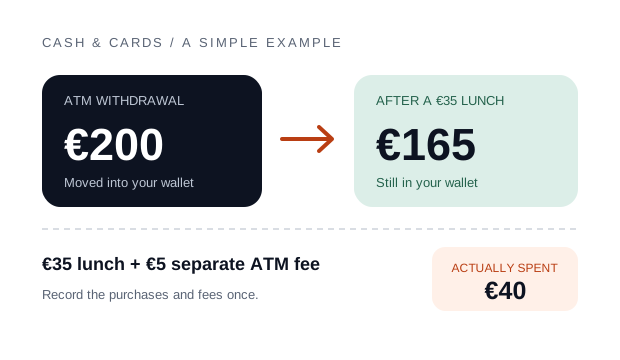
Suppose you withdraw €200 before a day in Barcelona. You have less money in your bank account, but you now hold €200 in cash. You still own that money.
When you use €35 to pay for lunch, your wallet balance drops to €165. The lunch is an expense. The movement from your bank account to your wallet is not another lunch, transport fare or activity cost.
For a purchase-based travel budget, the useful question is: what did I buy, and what did it cost? Cash and card are payment methods. They do not change whether a purchase belongs in your trip total. If you also pay in different currencies, our guide explains why your travel app total can differ from your bank statement.
A €200 withdrawal does not mean €200 spent
Let’s add a €5 ATM fee to the example. Assume the fee is charged separately to your bank account, so the machine gives you the full €200 in notes.
| What happened | Cash left | Trip expense |
|---|---|---|
| Withdraw €200 | €200 | €0 |
| Pay the separate ATM fee | €200 | €5 |
| Buy lunch with cash | €165 | €35 |
| After lunch | €165 still held | €40 spent in total |
Your bank account has paid out €205, but €165 of that is still in your wallet. The trip has cost €40 so far: €35 for lunch and €5 for the withdrawal fee.
If you record the €200 withdrawal, €35 lunch and €5 fee as expenses, your budget shows €240 spent. That overstates the real cost by the €200 you withdrew.
Where ATM and bank fees fit
Fees are different from the cash you receive. An ATM operator fee or a separate bank withdrawal charge is money you paid for a service. Include it once in your travel costs.
- Record a fee as its own expense if it appears separately.
- Choose a consistent category, such as Fees, rather than putting it under the meal you later bought.
- Check whether a fee is already included in a figure you entered. Do not add it again.
If the fee is deducted from the cash you receive, change the cash-balance example accordingly. The spending rule stays the same: record the fee once and the actual purchases once.
Record the currency in which each cost was charged. A fee charged in Australian dollars should not be entered as euros. ExpenseTravel can show expenses from different currencies in your chosen home currency.
A simple way to track cash and card purchases
- Record what you bought. Enter the amount in the currency you paid, whether it was lunch, a train ticket or groceries.
- Choose a useful category. Keep categories consistent so you can review spending later.
- Select the payment method. Use Cash for cash purchases and the appropriate label for card purchases.
- Add withdrawal fees separately. Leave the withdrawal principal out of your purchase totals.
- Check your entries each evening. Look for forgotten cash purchases and duplicates.
In ExpenseTravel, open the relevant trip and add each purchase. Choose Cash as its payment method and add a short note if useful. The expense-entry instructions explain how to add or edit a purchase. The app uses manual expense entry, so you do not need to connect a bank account.
This method tracks what the trip costs. If you also want to know exactly how much cash is in your wallet, keep a separate cash-balance note. A total of cash purchases is not the same thing as a wallet balance.
What if you cannot record every small purchase?
Use a quick phone note, then enter the expenses later. A note such as “market lunch, €9, cash” is enough for a personal budget, even when there is no receipt.
If you miss several purchases, compare your opening cash, any withdrawals and your closing cash. Allow for money you exchanged, transferred or received. Then compare the result with cash purchases you already recorded.
Only enter the unexplained difference as estimated spending. Label it clearly, and do not also add purchases that are already included in that estimate. You lose some category detail, but you avoid inflating the total.
Another option is to treat a withdrawal as a lump sum of cash spending. If you choose that approach, do not also log its individual purchases. It is less precise, particularly when you have cash left at the end of the trip.
A few common questions
Should I record the withdrawal and then record each cash purchase?
Not as two sets of expenses. If you record individual purchases, leave the withdrawal principal out of the spending total. A separate transfer record can be useful in a system that supports cash accounts, but a transfer is not another expense.
Does leftover foreign cash count as spending?
Cash you still hold is not a purchase. Keep it separate from what you spent. If you later exchange it, check any exchange fees separately. A change in its home-currency value is different from buying something with it.
How do I record a purchase paid partly in cash and partly by card?
If you want to track payment methods, enter the two paid portions separately with matching descriptions. Their combined amount should equal the purchase price. Do not then add the full purchase as a third entry.
Will my app total match the withdrawal on my bank statement?
Not necessarily. A bank withdrawal shows money moving out of the account, while a purchase-based trip total shows actual costs. Currency rates and separately charged fees can also affect the comparison. Read why your travel app total can differ from your bank statement for a worked example.
Once your cash purchases are clear, recalculate your remaining daily allowance using the money and days you have left.
Visit ExpenseTravel support for help entering expenses and choosing payment methods, or return to the travel budget guides.
Sources and scope
This guide covers personal travel budgeting, not tax deductions or employer reimbursement rules.